



Industry Knowledge & Buying Guides
Custom Luxury Furniture Insights
Expert articles on custom furniture manufacturing, hotel FF&E procurement strategies, and global wholesale trends.
Top 10 Bedroom Storage Ottoman Types for Global Buyers
Table of Contents
A bedroom is rarely only a place for sleep. It also stores blankets, books, clothing, toys, and daily clutter. A well-chosen Bedroom Storage Ottoman can bring these items within reach while keeping the room visually calm. It may sit at the bed’s foot, beside a dressing table, or under a window. The details matter. Lift-top access, washable fabric, strong hinges, and safe weight capacity can change the buying experience.
Market data supports this practical direction. Grand View Research valued the global home décor market at approximately USD 682.7 billion in 2023. It expects continued growth through 2030, driven partly by flexible, space-conscious interiors. Fortune Business Insights also reports sustained expansion in the global furniture market. However, these reports do not isolate storage ottomans. That gap deserves attention. Buyers need product comparisons, not broad market optimism.
William Morris, the influential designer and textile authority, offered a lasting rule: “Have nothing in your house that you do not know to be useful, or believe to be beautiful.” This principle fits the modern Bedroom Storage Ottoman perfectly. It should hide spare pillows, yet still look intentional. It should support seating, but not become unstable. Some models will suit compact apartments. Others will serve large master bedrooms or hospitality projects. No single style works everywhere.
This guide examines ten storage ottoman types for global buyers. It considers materials, construction, storage volume, comfort, maintenance, and room placement. It also recognizes an uncomfortable truth: attractive photos can hide weak frames and awkward lids. Careful comparison remains essential.
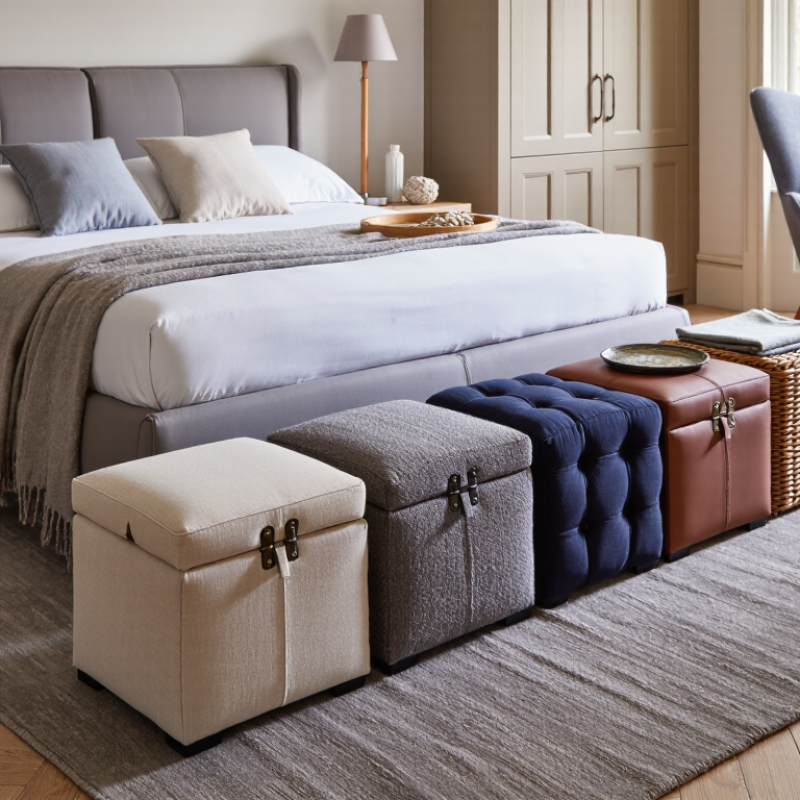
What Is a Bedroom Storage Ottoman?
A bedroom storage ottoman is a padded, movable seat or footrest with hidden internal storage.
Its hinged, lift-off, or sliding top conceals blankets, books, shoes, and seasonal clothing. Unlike a basic stool, it combines seating, organization, and visual softness beside the bed. It may be rectangular, round, square, narrow, end-of-bed, bench-style, folding, modular, or divided into compartments. These are ten practical types for global buyers, although categories can overlap.
Demand reflects a wider shift toward efficient homes. CSIL’s World Furniture Outlook reported that global furniture consumption exceeded US$1 trillion in 2023, supported by housing demand and urban living.
A storage ottoman fits smaller bedrooms, but size alone does not prove usefulness. Measure the bed width, walking clearance, lid swing, and storage depth before ordering. In my experience, a 120-centimeter bench can hold spare bedding comfortably, while a deep round model often wastes corners.
Check hinge strength, foam recovery, fabric abrasion results, and the stated weight capacity. For bedrooms, low-VOC materials and a stable base matter more than decorative stitching.
The American Society for Testing and Materials publishes relevant furniture safety and performance standards, but compliance claims should be verified through test documents.
It is not always simple.
A beautiful ottoman may open awkwardly, collect dust, or become too heavy when full. Global buyers should compare dimensions, packaging, care instructions, and return conditions in local units and language.
How Bedroom Storage Ottomans Are Classified by Design
Bedroom storage ottomans are best classified by opening method, structure, mobility, and visual form.
This approach helps buyers compare capacity, safety, and bedroom compatibility.
A lift-top ottoman offers deep storage for blankets and seasonal clothing. A hinged-box ottoman provides wide access, but its lid needs clearance. A drawer ottoman suits smaller rooms because drawers remain stable beside the bed. A open-shelf ottoman displays books, baskets, or folded linens. A cubby ottoman creates separate compartments for shoes and accessories.
Design changes more than appearance.
A bench ottoman combines seating with storage at the bed’s foot. A trunk-style ottoman emphasizes a firm frame and generous capacity.
A rolling ottoman supports flexible placement, though casters may mark soft flooring. A round ottoman softens corners and works well near dressing areas.
A modular or foldable ottoman supports compact homes and easier shipping. These are ten practical types, but categories can overlap.
For global purchasing, inspect upholstery abrasion ratings, foam density, hinge strength, and load-testing records.
A 100-centimeter bench may seat two adults, but published limits should guide decisions. Check ventilation gaps when storing textiles in sealed compartments. Fire labeling, packaging, and chemical restrictions vary by destination, so documents must match the market.
In product evaluation, appearance often receives too much attention. A beautiful ottoman can still wobble. I would question vague “large capacity” claims without internal measurements. That omission can cause expensive returns.
Key Features and Storage Functions of Each Ottoman Type
Top 10 Bedroom Storage Ottoman Types for Global Buyers
Bedroom ottomans now support both seating and space efficiency. Grand View Research forecasts steady global home-furniture growth through 2030, with online retail expanding quickly. Buyers therefore need measurable storage functions, not attractive upholstery alone. The lift-top ottoman offers deep storage for blankets and seasonal clothing. A hinged-lid ottoman gives faster access, but its lid needs clearance. Drawer ottomans separate watches, books, or cables neatly. Flip-top models open easily, though hinges may require careful testing. Cube ottomans suit compact rooms and stack efficiently.
Bench ottomans provide full-width seating at the bed’s end. Their long compartments can hold spare pillows and folded quilts. Round ottomans soften corners and usually hide smaller storage wells. End-of-bed ottomans maximize unused floor space without adding another cabinet. Modular ottomans let users connect seats, trays, or storage units. Folding ottomans travel well and store flat, but their frames can feel less substantial. Sometimes, simple wins.
According to Euromonitor International’s 2024 home-and-garden analysis, space-conscious living continues influencing furniture choices in urban markets. Buyers should compare internal volume, load capacity, ventilation, and opening force. The American Society of Furniture Designers also emphasizes proportion, usability, and material performance in residential furniture evaluation. A soft-close hinge may improve safety and comfort. Removable covers help with dust and minor spills. However, capacity claims can mislead when manufacturers measure external dimensions. I would check usable interior depth personally. A narrow opening can make a large compartment frustrating. Children’s rooms also need stable lids and controlled closing mechanisms.
How to Choose an Ottoman for Different Bedroom Needs
Top 10 Bedroom Storage Ottoman Types for Global Buyers
How to Choose an Ottoman for Different Bedroom Needs
Start with the room, not the catalog image. A narrow bedroom suits a hinged end-of-bed bench, a slim blanket chest, or a shoe-storage ottoman. Small rooms benefit from cube, round, and nesting ottomans. Larger rooms can accommodate drawer benches, window-seat ottomans, modular units, and lift-top chests. Measure the walking path first. Leave enough clearance to open the lid without striking the bed.
A lift-top ottoman works well for books, chargers, and folded bedding. Choose a firm-hinged lid for frequent use. A deep blanket chest stores bulky quilts, but it may become difficult to organize. Drawer designs improve access for smaller items. Upholstered benches feel warmer, while wood or leather-like surfaces usually clean more easily.
The Global Wellness Institute’s 2024 report valued wellness real estate at 438 billion dollars in 2023. This figure does not prove that an ottoman improves sleep. It does support thoughtful bedroom environments.
Material choice matters for global buyers. In humid climates, inspect ventilation, moisture resistance, and fabric drying time. In colder regions, dense upholstery can feel more comfortable. Look for rounded corners, stable hinges, and tested load ratings.
Check local dimensions, assembly instructions, and care labels. Avoid assuming every “storage” label means useful capacity. Some attractive models hold surprisingly little.
I learned this the hard way. A practical test is simple: place one folded blanket inside before buying.
Global Buying Factors: Materials, Sizes, Safety, and Shipping
Top 10 Bedroom Storage Ottoman Types for Global Buyers
Bedroom storage ottomans include lift-top, drawer, hinged, foldable, cube, bench, round, rolling, upholstered, and toy-storage designs. Each type serves a different room layout and buying purpose. A lift-top model suits bedding, while a rolling ottoman works well beside a wardrobe. I have found that sturdy plywood or kiln-dried hardwood frames resist daily movement better than thin composite boards. Solid wood can last longer, but it increases weight and shipping costs.
Material choice affects comfort, safety, and international delivery. Use tightly woven fabric for frequent handling and easy cleaning. Avoid sharp corners, unstable hinges, and weak gas-lift hardware. A slow-closing mechanism helps protect fingers. Check foam performance, fabric composition, and formaldehyde information before ordering. Do not assume every “eco” label means the same thing worldwide. Verify destination-market safety requirements with the supplier and importer.
Measure carefully. A 40-centimeter-high ottoman may fit a bed, but it could block a low drawer. Small cube units often ship efficiently, while large benches need stronger cartons and corner protection. Ask for packed dimensions, gross weight, pallet details, and moisture-resistant wrapping. Delivery damage remains a real risk. I once underestimated corridor clearance, and the oversized carton could not enter the room. That mistake changed my buying checklist: confirm door widths, assembly steps, replacement-part support, and inspection procedures before payment.
Top 10 Bedroom Storage Ottoman Types for Global Buyers
Indicative comparison of common ottoman formats by typical internal storage capacity. Actual capacity varies by construction, padding, and dimensions.
Large blanket boxes and bedroom benches generally provide the highest storage volume, while round ottomans and compact cubes are easier to place in smaller bedrooms. Global buyers should also verify material durability, child-safe hinge or lid operation, weight capacity, packaging protection, and shipment dimensions before purchase.
FAQS
It provides seating and hides blankets, pillows, clothing, books, or chargers. Sometimes, simple wins.
Cube, round, folding, and nesting ottomans fit compact rooms well. Measure the walking path first. Leave space for opening lids and drawers.
Yes, its deep compartment can hold quilts, blankets, and seasonal clothing. However, deep storage can become messy. Use separate bags or small boxes inside.
Drawers offer quicker access to watches, cables, books, and smaller belongings. Hinged lids usually provide larger storage space. The lid needs enough clearance.
Measure the ottoman, bed height, walking route, doorways, and nearby drawers. A 40-centimeter height may block a low drawer. Check usable interior depth, not only external size.
In humid areas, inspect ventilation, moisture resistance, and fabric drying time. Tightly woven fabric handles frequent use. Wood-like surfaces often clean more easily. Do not trust every “eco” label equally.
Choose rounded corners, stable hinges, controlled closing, and tested load ratings. A slow-closing lid helps protect fingers. Children’s rooms need extra lid stability. Safety details deserve careful checking.
Place one folded blanket inside before purchasing when possible. A narrow opening may make a large compartment frustrating. I once judged capacity from appearance alone. That was a poor test.
Request packed dimensions, gross weight, pallet details, and moisture-resistant wrapping. Large benches need strong cartons and corner protection. Confirm door widths and assembly steps. Oversized cartons can fail at the hallway.
Conclusion
A Bedroom Storage Ottoman is a versatile piece of bedroom furniture that combines comfortable seating with practical hidden storage. This article introduces ten common types, classified by design features such as hinged lids, lift-top mechanisms, drawer systems, bench shapes, compact cubes, and modular forms. Each type offers different advantages in accessibility, capacity, mobility, appearance, and space efficiency, helping buyers understand which structure best suits their room layout and daily habits.
The guide also explains how to select an ottoman for needs such as storing bedding, clothing, books, accessories, or seasonal items. For global buyers, important considerations include material durability, upholstery maintenance, dimensions, weight capacity, ventilation, child-safe hinges, stable construction, and overall safety. Shipping size, packaging protection, assembly requirements, and destination-specific purchasing conditions should also be evaluated. By comparing design, function, quality, and logistics, buyers can choose a storage ottoman that provides lasting value and fits both personal preferences and bedroom requirements.

Blog Tags: